
SEO Performance Test
We have used here the content wrapper component more like as a glue to hold all other components, texts and images. This helps the page be consistent and same in all devices regardless the screen size. So, it is highly recommended to use the content wrapper component to contain other components.
For any Headline it is also recommended to use this big blue bar, if the content fits
Different levels of tracking granularity
Please use the justified allignment style in case you are planning to insert longer texts in the copy text component. Check below for reference.
For Work Package or similar contents, you can use the Vertical Tabs component like below:
-
Work Package 01
-
Work Package 02
-
Work Package 03
-
Work Package 04
-
Work Package 05
-
Work Package 06
ARTs Journey Readiness with Tracking
Work items
OE Onboardings & Readiness Check
Work items
DAS Tracking Rules Migration
Work items
DAS team updates the OE on the status of this migration, possible issues or other dependencies
DAS team will not take care of local dependencies, custom consent management or custom hosting of journey, or things falling in similar areas
OE Quality Check + Go-live
Work items
DAS Analytics Dashboard (Basic)
Work items
OE Customization + Additional Requirements
Work items
For How or works, Use cases or similar contents, you can use the Tabs component like below:
-
Use Cases
-
Self-Service
-
Pricing
For FAQ or similar contents, you can use the Accordion component like below:
How can you make use of the analysis results regarding anomalies?
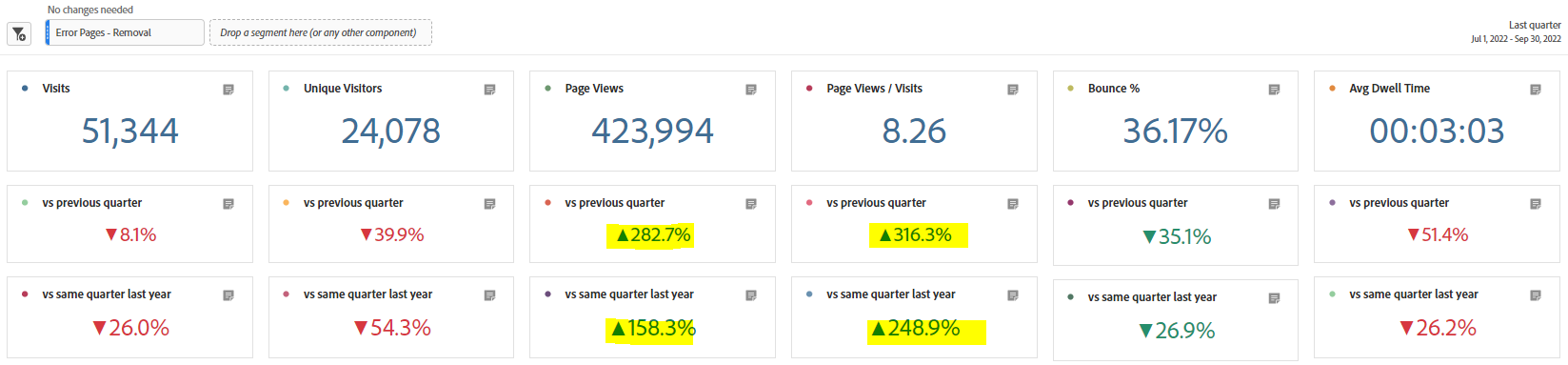
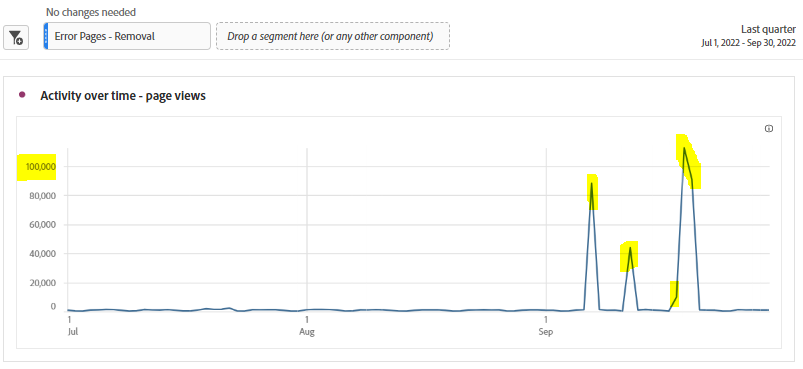
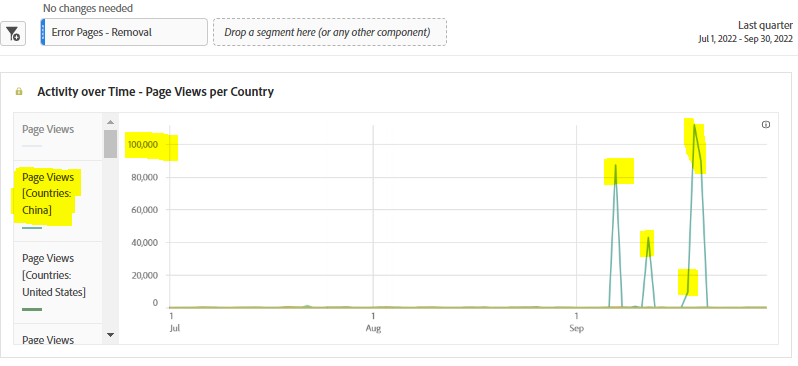
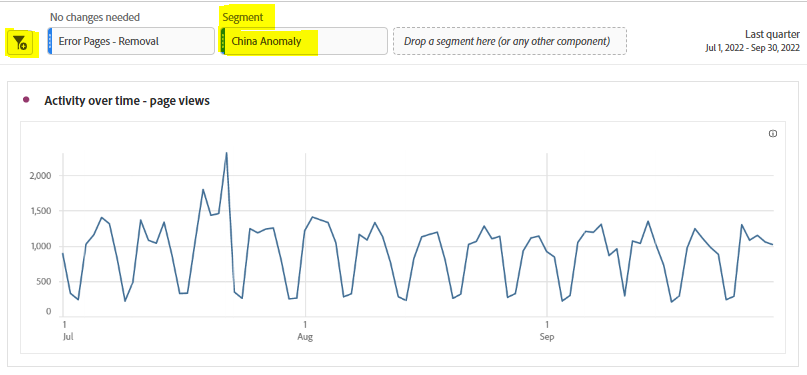
The issue is that all KPIs of Q3/2022 in the overall KPI overview are skewed by the anomalies. As a consequence, the KPIs cannot be used as basis for an analysis of actual user behaviour. To overcome this issue, a segment can be created, e.g. called "China Anomaly", which is used as a filter for the overall KPI overview panel. Because we know from the analysis before that the anomalies are assigned to the country of origin "China" and that they appeared on 07th, 12th, 18th, 19th and 20th of September 2022, we can exclude all hits from the segment that meet these criteria.
The subsequent line graph shows the development of the number of page views in Q3/2022 on a daily basis after filtering by the "China Anomaly" segment. You can see that there actually were page views in Q3/2022, unlike it seemed to be the case in the line graph before filtering by the "China Anomaly" segment.
KPI Analysis
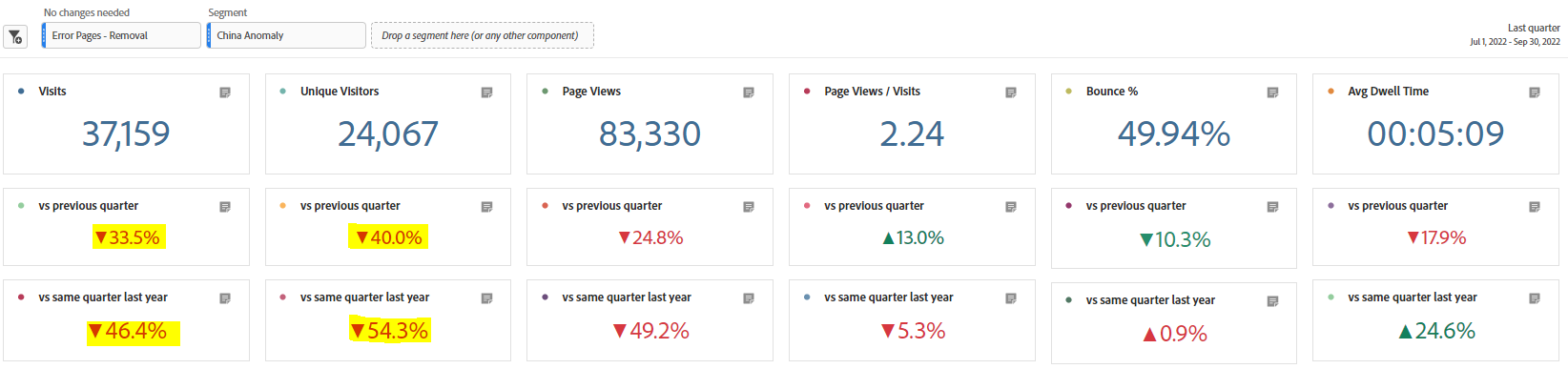
As you can see in the subsequent figure, for a certain website, KPIs such as visits, unique visitors, page views, page views/visit, bounce rate or average dwell time, are summarized in an Adobe Analytics panel for the last quarter (here: Q3/2022). To be able to assess the KPIs´ values better, the numbers of the last quarter are compared to the numbers of the quarter before (here: Q2/2022, second row) and to the numbers of the same quarter of the year before (here: Q3/2021, third row).
The decrease in the number of visits and unique visitors in Q3/2022 compared to Q2/2022 and Q3/2021 is extraordinary high (marked in yellow). Therefore the number of visits and unique visitors should be analyzed in more detail.
One option for a more detailed analysis of the number of visits in Q3/2022 compared to Q2/2022 is the analysis of the number of visits over time on a daily basis. In the subsequent line graph you can see that the number of visits dropped in May 2022 and then continuously remained at a lower level as in the months before. We know from the OE that there was an tracking error in May 2022, which caused the immense drop in visits in May 2022. However, the constantly lower level of the number of visits after the dropping could not be explained by the tracking error.
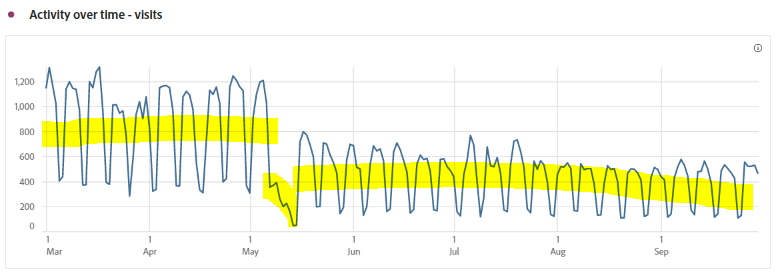
Based on our experience, we know that there can be several reasons for a decrease in the number of visits. The most prominent reason are changes in the cookie policies based on GDPR, which result in a decrease in tracking of visits. Nevertheless, this could not be the main reason for a decrease of 33.5% in the number of visits in Q3/2022 compared to Q2/2022. So we searched for hints in the data what could have caused the continuously lower number of visits in Q3/2022 compared to Q2/2022.
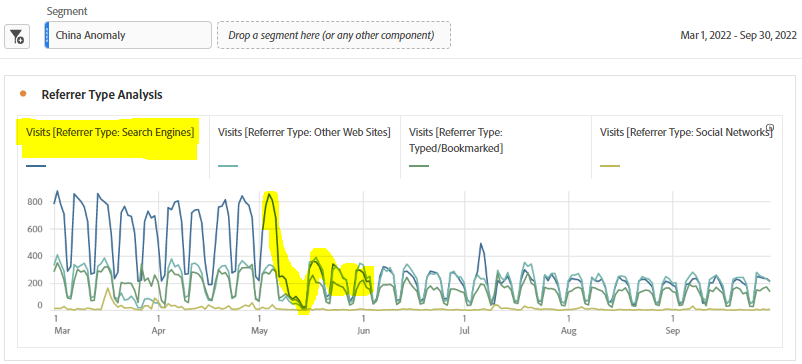
The subsequent visualization shows the development of the number of visits over time on a daily basis depending of the referrer type. Since May 2022, you can see a decline in the number of visits with the referrer type "Search Engines", while the number of visits of the other referrer types remained on a similar level as before. The hereupon conducted research regarding search engine changes in May 2022 revealed that Google conducted a so-called "Core update" in the end of May 2022, where the search algorithm and systems were changed and which affected a website´s Google search ranking.
How can you work with the analysis results?
In the underlying use case, we connected the OE to the SEO community, in which DIXD / AZ Tech colleagues discuss with several OEs, for example, the impact of the Google core update of May 2022 and how to deal with it, i.e. how to improve a website´s Google search ranking in the future.
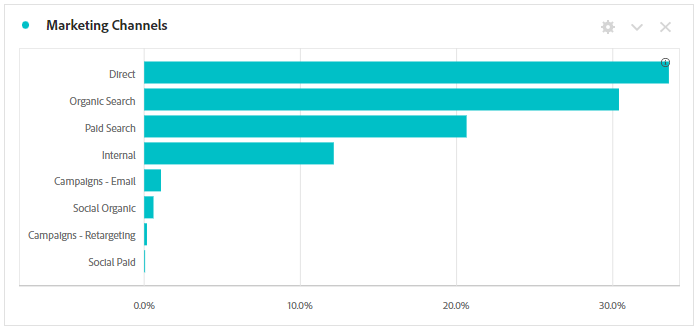
Marketing channels are commonly used to provide insight on how visitors arrive to your website, how paid measures or campaigns perform, also compared to non-paid measures, or to filter traffic based on marketing channels. Moreover, the knowledge about the traffic of the different marketing channels helps you, for example, to set up personalization use cases, which are also described on this website.
Marketing channels are not set up automatically by Adobe Analytics. We can support you in the definition of marketing channel processing rules, i.e. what channels you want to track and how you want to track them. Here are some marketing channel examples from a customer project, which are also reflected in the diagram below:
- Direct: a visitor that comes to your website directly, such as from a favorites link or by pasting a link in their browser.
- Organic Search: a visitor finds your website through a web search, where the search engine ranked your site without paying for the listing.
- Paid Search: a visitor comes to the website through a paid placement in search results of a search engine.
- Internal: a visitor came from within the site to start the visit, e.g. after a session refresh.
- Campaign - Email: visitors originating from an email campaign.
- Social Organic: a visitor originates e.g. from facebook, linkedin, twitter.
- Campaigns - Retargeting: a visitor originates from a retargeting campaign.
- Social Paid: a visitor originates from a campaign on social channels, e.g. facebook, linkedin, instagram.
UTM parameters are variants of URL parameters used by marketers to track the effectiveness of online marketing campaigns across traffic sources and publishing media. The UTM parameters in a URL identify the campaign that refers traffic to a specific website, and attributes the browser's website session and the sessions after that until the campaign attribution window expires to it.
The following utm parameters are most popular:
- utm_source: used to identify a search engine, newsletter name, or other source, such as linkedin or twitter.
- utm_medium: used to identify a medium such as email or cost-per-click.
- utm_content: used to to differentiate ads or links that point to the same URL.
- utm_campaign: used to identify a specific product promotion or strategic campaign.
To define and append the relevant UTM parameters to the appropriate URLs, you can use simple, spreadsheet-based, or automated UTM builder tools, such as the Google Analytics URL Builder.
Example: URLs for a survey about the oneMarketing sprint review in March 2023 which was accessible via an email sent out through Adobe Campaign and via a QR code. The survey was sent out in the framework of oneMarketing "Engagement Layer" campaign.
- https://experience-digital-lab.onemarketinguxp.com/en_GB/sprint-review-survey-March-2023-1.html/?utm_source=email&utm_campaign=om-engagement-layer&utm_content=sprint-review-survey-2023-03&utm_medium=om-email
- https://experience-digital-lab.onemarketinguxp.com/en_GB/sprint-review-survey-March-2023-1.html/?utm_source=email&utm_campaign=om-engagement-layer&utm_content=sprint-review-survey-2023-03&utm_medium=om-qrcode (Edit: a better option for a utm_source parameter value would have been "sprint-review" as the QR code was shown in the sprint review)
The traffic coming through the URLs with the different utm parameter values to your website can be analyzed using Adobe Analytics. As you can see in the screenshot below, you can analyze the values of each utm parameter separately, but also in combination.
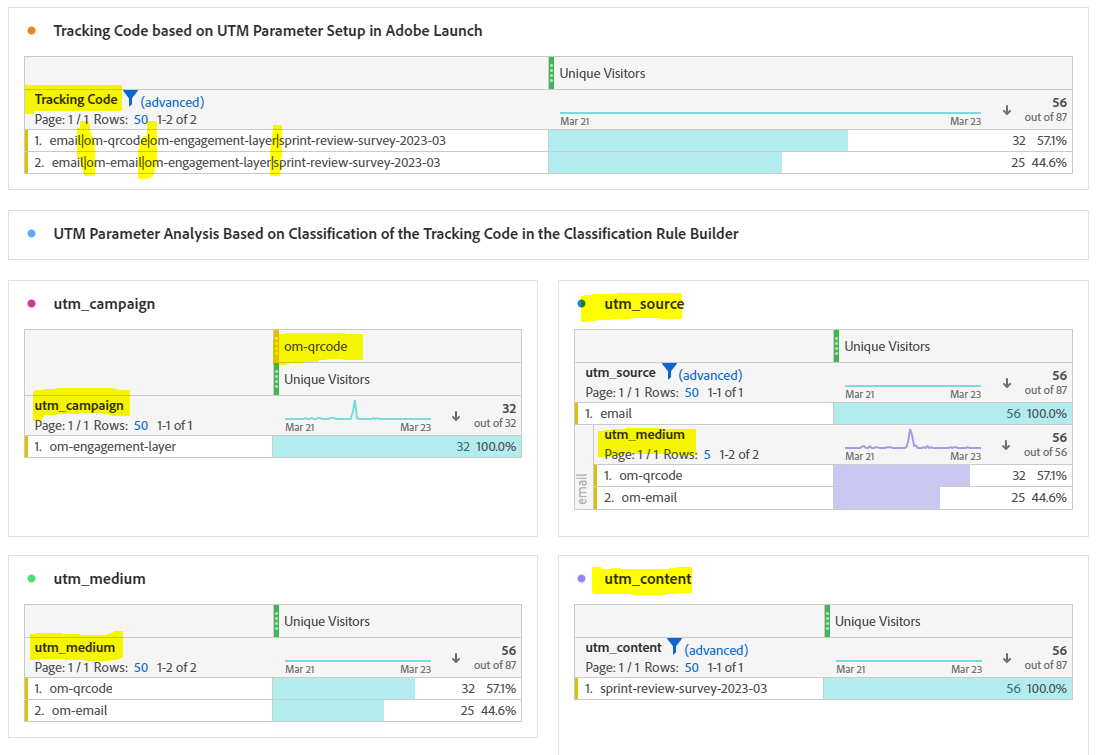
Prerequisite is that you follow a consistent utm parameter setup and that utm parameter tracking is set up:
- evar0 / Tracking code setup in Adobe Launch: e.g. Campaign value equals %c_tracking.utm_source%|%c_tracking.utm_medium%|%c_tracking.utm_campaign%|%c_tracking.utm_content%
- Classification of the evar0 / Tracking Code values in Adobe Analytics via Classification Rule Builder
We can help you with the setup. The contact details of the ECS team can be found below on this page.
In case of background color, pleaes select either the grey or the blue from below. It is recommended to use the grey background more because too much blue can cause distraction.
Why do we use it?
It is a long established fact that a reader will be distracted by the readable content of a page when looking at its layout. The point of using Lorem Ipsum is that it has a more-or-less normal distribution of letters, as opposed to using 'Content here, content here', making it look like readable English. Many desktop publishing packages and web page editors now use Lorem Ipsum as their default model text, and a search for 'lorem ipsum' will uncover many web sites still in their infancy. Various versions have evolved over the years, sometimes by accident, sometimes on purpose (injected humour and the like).
Why do we use it?
It is a long established fact that a reader will be distracted by the readable content of a page when looking at its layout. The point of using Lorem Ipsum is that it has a more-or-less normal distribution of letters, as opposed to using 'Content here, content here', making it look like readable English. Many desktop publishing packages and web page editors now use Lorem Ipsum as their default model text, and a search for 'lorem ipsum' will uncover many web sites still in their infancy. Various versions have evolved over the years, sometimes by accident, sometimes on purpose (injected humour and the like).